
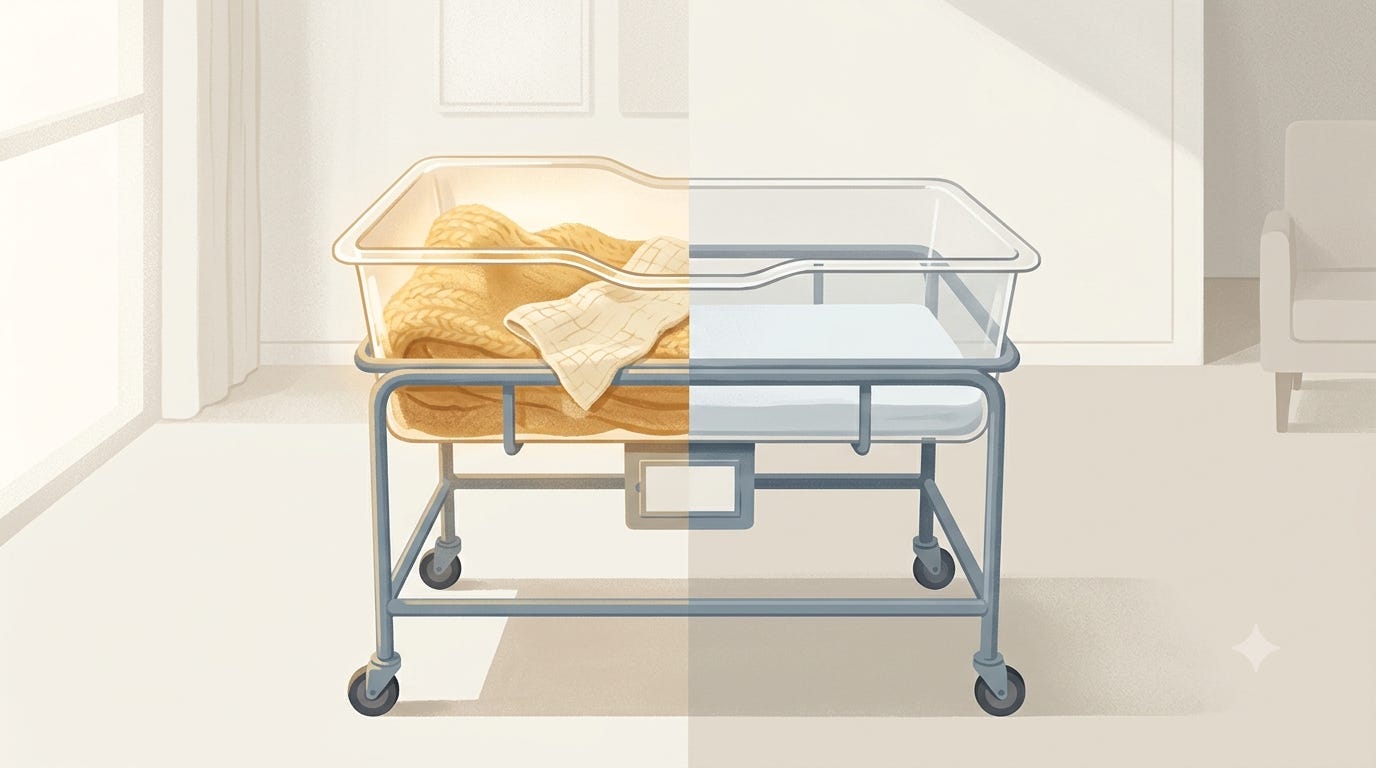
Born without cover
An important post for young couples you know.

Hello Hello 👋
If you’re already a parent, this edition comes a little late for you personally.
But I would ask you to read it anyway and then forward it to someone who’s still in the planning stage. A younger sibling. A colleague. A friend from college. What I’m about to share is something most couples only discover after the fact, when it’s too late to do anything about it.
And if you're already a Beshak customer, you may not have heard this from us when we helped you set up your plan. I'll be honest, I discovered this only recently, while researching for a video. Better late than never.
I always felt maternity cover was useless.
Too expensive. Too many conditions. Too long a waiting period. I thought it was one of those insurance products that sounds good but rarely pays off.
Then I started researching for a video on maternity plans. And I changed my mind completely.
Not because of delivery expenses. Something bigger.
Delivery expenses are the part you can plan for
Pregnancy is, almost always, a planned event. You know the hospital you want. You have a rough idea of the expected date. The doctor gives you a package cost.
A normal delivery at a private hospital in a metro city runs ₹50,000 to ₹75,000. A C-section can go from ₹1.5 lakh to ₹2 lakh and above. Big numbers. But not surprises. You can estimate them, budget for them, set money aside in advance.
This is why delivery expenses, while important, are not the biggest financial risk in childbirth. They’re foreseeable.
The part that catches parents off guard
Childbirth doesn’t always go exactly as planned.
Imagine a healthy pregnancy. Regular check-ups, no red flags. The delivery goes smoothly. And then, within hours, the baby is moved to the NICU.
This happens more often than most parents expect. About 5% of newborns in India require two to three months of NICU care for serious conditions.
And the risk of running into exactly these complications is rising in urban India.
High-risk pregnancies are rising among urban Indian women, driven by delayed motherhood and lifestyle diseases. Couples in cities are planning babies later. Career first, financial stability first, then family. That's a reasonable choice. But it changes the risk profile. A study published on NCBI found miscarriages in urban India rose from 6.4% to 8.5% between 2015 and 2021, and peer-reviewed research links delayed maternal age directly to higher rates of premature birth, low birth weight, and chromosomal conditions in newborns. IVF and assisted reproductive technologies are adding to this further.
NICU costs depend on the hospital, city, and level of care. At a private hospital, treatment can run from ₹10,000 to ₹75,000 per day. A two-week stay in a mid-range private hospital in Bangalore or Mumbai can cross ₹5 lakh. Extended stays go much higher.
I have personally seen birth complications take families 3 to 5 years back financially. Savings wiped. Debt taken. And the baby still in treatment.
If you want a sense of what this looks like in real life, go to any crowdfunding site like ImpactGuru. The most common fundraisers you’ll find are for newborn baby complications. One family on that platform has already spent ₹12 lakh on treatment for their newborn son. They’ve exhausted their savings and sold their gold. The bills are still growing.
These are not rare edge cases. They’re the predictable result of an unpredictable event, without any cover in place.
Why your existing health policy may not help
Most people with a family floater assume the baby is covered from birth. The reality is different.
Most standard health insurance plans in India only cover a newborn from the 91st day of life. In the first 90 days, the baby is typically not on the policy. If the baby needs NICU care in week one or week three, every rupee comes from your pocket.
Most people ask one question when shopping for maternity cover. “How much does this policy pay for delivery?”
The better question is this. “If my baby needs treatment on the day of birth, will this policy pay?”
The answer varies across plans.
What is Zero-Day Baby Cover?
Zero-Day Baby Cover is a feature in select health insurance plans, either inbuilt or as an optional add-on. It covers medical expenses for the newborn from the moment of birth.
When you have this cover, you are essentially guaranteeing that the baby has health insurance from the moment she arrives, regardless of what happens. No gap. No waiting to add her to the policy at 91 days. No out-of-pocket NICU bills in week two.
Most of these plans work the same way. The maternity claim must first be admissible. Once the delivery claim is accepted, the newborn’s cover activates. Coverage typically runs for up to 90 days from birth.
Each plan has its own scope. What is covered, what is excluded, whether there is a separate sub-limit for the newborn, which conditions are included or left out. These details differ across plans and reading the policy wording matters.
The maternity benefit itself comes with a waiting period. For most retail health plans, this is 24 to 48 months. A few plans offer shorter waiting periods, with the lowest available in retail plans currently being 9 months. This is not something you buy when you’re already pregnant. You need to buy it well before you start planning.
The risk most parents never think about
This is the part that stopped me while researching.
If a newborn is not covered under Zero-Day Baby Cover, and receives medical treatment at birth, that medical history is now on record. When the parents later try to add the baby to their health policy, the insurer knows exactly what was treated.
If the baby was treated for a birth defect or a congenital condition at birth, the insurer may load the premium, add exclusions for those conditions, or decline to include the baby in the policy altogether.
I have personally seen this happen. The baby had complications at birth. There was no newborn cover. When the parents tried to include the baby in their family floater at renewal, the insurer declined. The family now has a child with a documented medical history and no insurance willing to cover those specific conditions.
Worth knowing though: Zero-Day Baby Cover doesn't guarantee the baby will be added to the policy without conditions after 90 days. Most insurers will still do underwriting when the baby is enrolled as a regular member. But what it does protect against is the immediate financial crisis. The bills for those first 90 days don't fall entirely on you. At a private NICU, that alone can be several lakhs. That's the protection that actually matters in those first hours and weeks.
Check your employer’s group health insurance first, but don’t stop there
Before buying a retail plan, check what your company’s group policy covers.
Most employer-provided group health insurance in India covers maternity from Day 1 with no waiting period. Several corporate policies also include newborn cover from Day 0 without extra premium. If you’re in the planning stage and your employer offers this, it’s a real advantage, especially when retail plans require years of waiting.
But there’s a catch that most people miss.
If you use your employer’s zero-day cover for the birth, and then change jobs or leave the company, that cover ends. The baby at that point has a documented NICU history or treatment record from the birth period. When you try to get individual insurance for the child after leaving, the insurer sees that history. You may face the same problem I described above.
Your own retail policy at least ensures you have continuity of your own cover regardless of where you work. The post-90-day underwriting question exists either way, but you're not starting from zero.
Some corporate plans also cap the maternity benefit at ₹25,000 to ₹50,000, which doesn’t go far at a private hospital in a metro city. A few policies have a 7-day or a 30 day gap before newborn cover kicks in.
Check your policy wording. Find out whether newborn cover is included, what the limit is, and whether it starts from Day 0 or after a gap. Use the employer cover if it’s available and comprehensive. But use it as a starting point, not a complete plan.
Upgrade your sum insured before you start planning
A small thing that matters more than it looks.
If you’re planning a baby, upgrade your health insurance sum insured to an adequate number before you start. Not during the pregnancy. Before.
Here’s why. If the baby has complications at birth and you later want to move from, say, a ₹5 lakh policy to ₹25 lakh, the insurer looks at the medical history of everyone on the policy, including the newborn. A baby with a documented condition may lead to restrictions on any increase. The upgrade may get blocked, or come with exclusions for those specific conditions.
Do it before. It’s much simpler that way.
The practical takeaway
Two paths are available.
Buy a plan that includes Zero Day Baby Cover, with the maternity waiting period already served. Understand the specific cover, the sub-limits, the exclusions, and the trigger conditions before you need them.
Or keep a separate fund for newborn complications. At ₹10,000 to ₹75,000 per day in a private NICU, even a two-week stay can become a multi-lakh expense very quickly. Size the fund accordingly.
Ideally, do both.
The bottom line
Delivery expenses are important. But delivery is usually the predictable part of childbirth.
What happens in the first hours and days after the baby is born is where the real financial risk sits. That’s where families get caught. That’s where savings disappear.
No parent plans for this. But some babies arrive in the world born without cover. And the window to fix that closes the moment the baby is born.
Ask about Day 0.
And if you know someone in the planning stage, send them this.
Next Steps:
If you already have a cover, but now are planning a baby, you can migrate to a plan with maternity and zero day baby cover.
If you need any help in choosing the right plan, you can reply to this email, and I will help you connect with the right vetted expert who can help.
Regards
Mahavir
Founder, CEO
Beshak
Can’t stress how important this is. We all think “it won’t happen to me,” but life doesn’t always follow the plan. Think of this cover as an investment that protects your baby and your savings if things ever take a bad turn.